
Blog
Another turbulent year: A roundup of 2021–22 accomplishments for faculty, coaches
While the 2021– 22 academic year was turbulent, APSCUF faculty and coaches continued to impress. Here is a roundup of some of their accomplishments.
Bloomsburg University’s Michael Shepard, Department of Environmental, Geographical & Geological Sciences professor, mapped the largest m-class asteroid in our solar system.
Mark Lennon, associate professor at California University of Pennsylvania, will be teaching management concepts in India as part of the Fulbright Specialist Program.
Cheyney University of Pennsylvania Professor Marietta Dantonio-Madsen spoke with PHL17 about the “Keep Black Love Alive” initiative to increase vaccinations in communities of color.
Kevan Yenerall, Clarion University professor, published a chapter titled “Pennsylvania: A new Bellwether?” in “The 2020 Presidential Election: Key Issues and Regional Dynamics.”
East Stroudsburg athletic trainer Jayme Galdieri was selected as medical director for Team Pennsylvania for the 2022 Special Olympics USA Games.
Edinboro Professor Sam Claster discussed Edinboro University’s new certificate program in cannabis science on the “Tartan Talks” podcast.
Chauna Craig, professor of English at Indiana University of Pennsylvania, was selected as the Honors Professional of the Year.
Kutztown University Professor Kurt Friehauf was awarded the 2021 Arthur and Isabel Wiesenberger Faculty Award for Excellence in Teaching.
Lock Haven University softball Coach Kelly Shannon earned her 300th and 301st career win, sitting as second all-time at LHU.
Timothy Madigan, associate professor of sociology at Mansfield University, discussed the Chinese Lantern Festival on China Global Television Network.
Millersville University Professor Dawn Lambert received the Pennsylvania Association of School Nurses and Practitioner’s 2022 School Nurse Administrator Excellence Award for the Southeast Region of Pennsylvania.
Shippensburg University Professor Scott Madey shared all about his latest book, “Music, Wellness, and Aging: Defining, Directing, and Celebrating Life,” on ABC27 news.
Melissa Ford, assistant professor of history at Slippery Rock University, published “A Brick and a Bible,” recounting African American women’s radical activism during the Great Depression.
West Chester University Professor John Kennedy discussed the race for Senate in Pennsylvania on PHL17 news.
Thank you for your outstanding work and perseverance. APSCUF strives to keep all members and followers up to date on our faculty members’ and coaches’ successes. Have a story to share? Tag APSCUF on social media or email us at .
—Madison Johnson,
APSCUF intern
Intern looks forward to furthering APSCUF’s mission
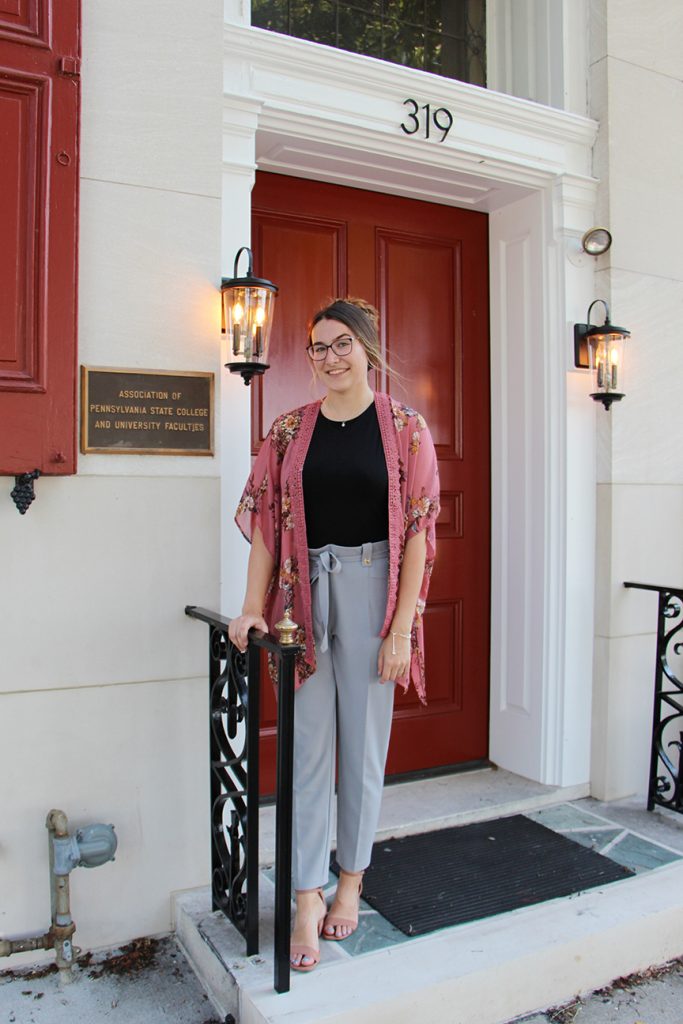
Shippensburg University student Madison Johnson will intern with APSCUF’s government-and-communication department through August. Click here to learn more about APSCUF internships.
My name is Madison Johnson, and I am a student at Shippensburg University. I am entering my senior year, majoring in public service. I am a member of the Pi Sigma Alpha National Political Science Honor Society, and I am a member of the Shippensburg University Red Raider Marching Band. I will be continuing my education at Shippensburg in the Master of Public Administration program.
Throughout my time at Shippensburg, I have developed important professional relationships with my faculty members. Thanks to these connections, I have been afforded educational opportunities. Although Pennsylvania’s State System of Higher Education faculty focus on researching, preparing lectures, and teaching, they spend a great deal of time mentoring and assisting their students in ways that encourage them to grow. I am proud to work with an organization that has been a profoundly incredible advocate for PASSHE professors and for our students, especially in advocating for greater funding for state-owned universities. I share the organization’s value of providing quality higher education to Pennsylvania students. I look forward to being a productive member of APSCUF’s mission!
—Madison Johnson,
APSCUF intern
Thank you, President Martin

Dr. Kenneth M. Mash, left, and Dr. Jamie Martin in 2019. APSCUF file photo
Thank you to Dr. Jamie Martin for your service as APSCUF president for the past two years (and in countless other roles throughout your time with APSCUF) and to Dr. Kenneth M. Mash for your continued presidential service.
Calling APSCUF? Take note

Planning to call the State APSCUF office? We’ve updated the phone system and now exclusively use the phone number 717-236-7486 (our existing number). The 800-number is no longer active.
See Dr. Jamie Martin’s remarks to the Board of Governors – May 6, 2022
The May 6 Board of Governors meeting was streamed via YouTube. Below are APSCUF President Dr. Jamie Martin’s comments as prepared.
Chairwoman Shapira, Chancellor Greenstein, governors, university presidents and guests,
I realize that, at the last BOG meeting, I stated that those would be my final comments to all of you — and I thought that they would be. However, when I saw the agenda for today’s special meeting, I thought it imperative to provide brief remarks about the agenda item regarding the appointment of a permanent president at Shippensburg University. These comments are in no way directed at the individual selected, but rather at the search process leading to this selection. It is important to consider the radical changes that have occurred in presidential leadership at our universities.
Over the last couple of years, eight university presidents have retired, resigned to take new positions, were reassigned to the Office of the Chancellor, or appointed the interim presidents at other universities. The list: President Welsh (East Stroudsburg), President Jones (California), President Carter, (Shippensburg), President Huang (Edinboro) President Pignatello (Lock Haven), President Hanna (BU to Lock Haven and Mansfield), President Pehrsson (Clarion to Edinboro and California) and President Patterson (Mansfield to Ship).
These changes involved three women presidents (Carter, Jones and Welsh) who left the System, and two of them were women from historically marginalized groups. At present, only one woman president remains. Nine of 10 university presidents are men, and only two of them are from historically marginalized groups (President Walton and Interim President Long), and only two others have ethnically diverse backgrounds (President Wubah and President Hanna). The remaining are white men.
The appointment of a president of a university is an important and significant decision, as the president sets the strategic plan for the university, leads fundraising efforts and is the face of the university — to name just a few things that the president is responsible for.
At a number of BOG meetings, the importance of diversity, equity and inclusion on our college campuses has been emphasized. This includes the strengthening of the curriculum to include DEI elements and diversifying faculty, staff and — I would like to think — leadership teams at our universities, including our presidents. In fact, these goals have been referred to as a guiding principle or “North Star” to which we all should be committed.
The Board of Governors Policy 1983-13-A lays out the process for recommending presidential appointments and the procedure for accomplishing such. I will not read that policy in its entirety but want to highlight one important element of the procedure that is outlined to implement that policy. Procedure C.1 states the following:
The chancellor is directed to create procedures and standards to comply with this policy. Such procedures and standards shall support the generation of diverse candidate pools.
It does not appear as if this procedure was followed. An announcement of the opening of the president of Shippensburg was never posted: In other words, no national search occurred. Absent a national search, it is not possible to generate a diverse candidate pool. Because of that, it is impossible to consider the appointment of a person from a historically marginalized group or someone from an ethnic background.
We all know why diversity is so important: It is critical to helping us explore new ideas and exposing us to different perspectives and experiences. Diversity promotes critical thinking and broadens and enhances our understanding of the world. The fact that the leaders of our universities have become less diverse is troubling, and I think it is important to question why this has occurred. It is further important to ponder if these decisions align with the guiding principles that have been outlined by the BOG.
Further, if the Board truly believes that diversity is important for our System as a whole, there should be caution about disregarding its own policies. When the Board disregards its own policies, it undermines its authority and forces others to question the legitimacy of its governance.
Thank you for your time.